Module 1 · the chemistry
The reaction & all the molecules
Real structures, drawn from verified chemistry: D-luciferin (the fuel), the luciferyl-AMP intermediate, and oxyluciferin (the spent, light-emitting product) — plus the two-step luciferase mechanism. Step 1 activates luciferin with ATP (mechanistically like a polymerase); step 2 uses oxygen to make an excited product that releases a photon.
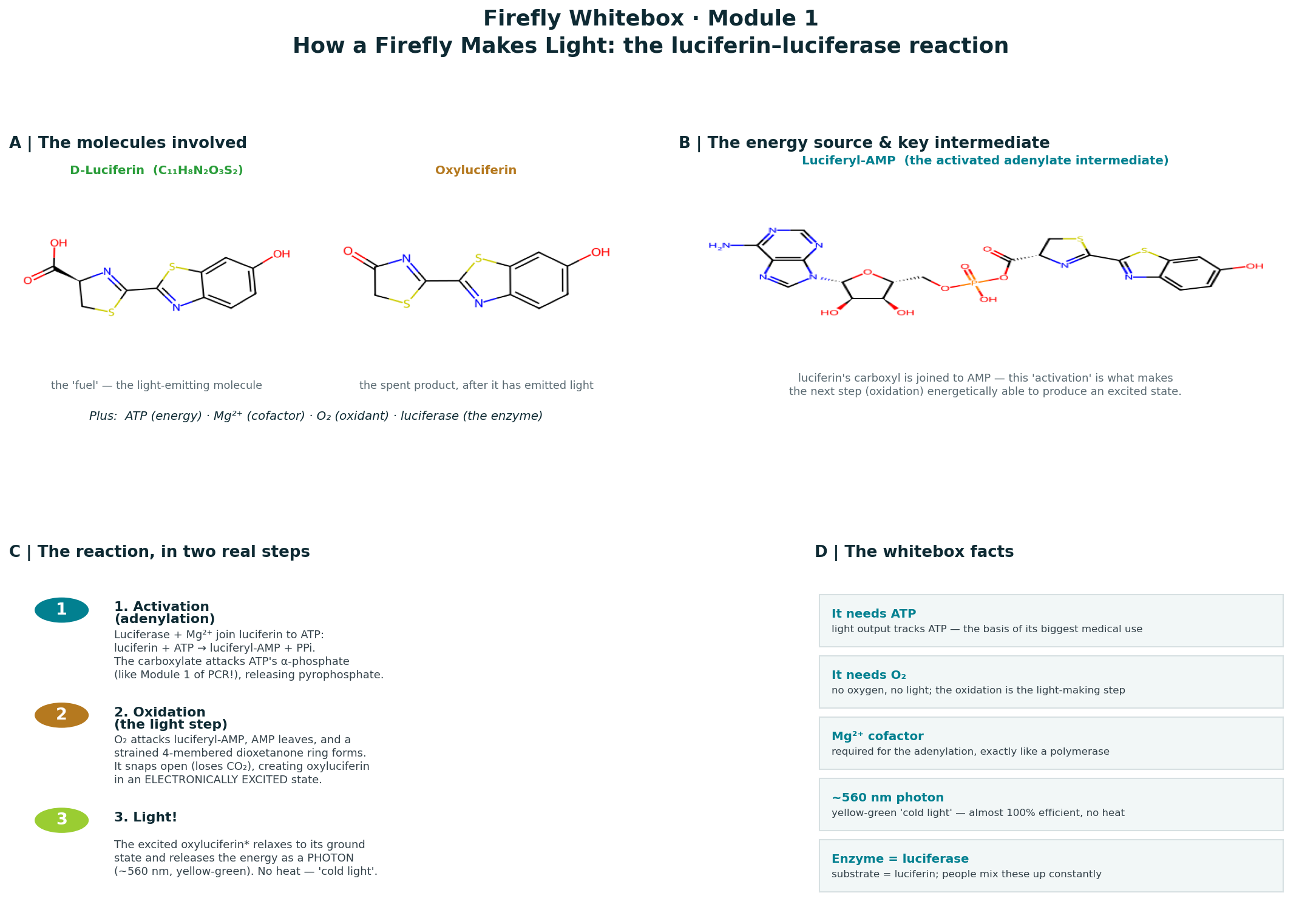
The heart of it: light comes from an electronically excited oxyluciferin relaxing to its ground state — chemiluminescence via a strained dioxetanone ring that ejects CO₂. The reaction needs ATP, oxygen, and Mg²⁺.
Module 2 · the payoff
Applications in the medical field
Because the reaction's light output depends on ATP, and because the luciferase enzyme can be encoded as a gene, the firefly reaction became a measurement tool: detecting living contamination, imaging tumors and infections inside living animals, screening drugs, and measuring whether cells are alive or dying.
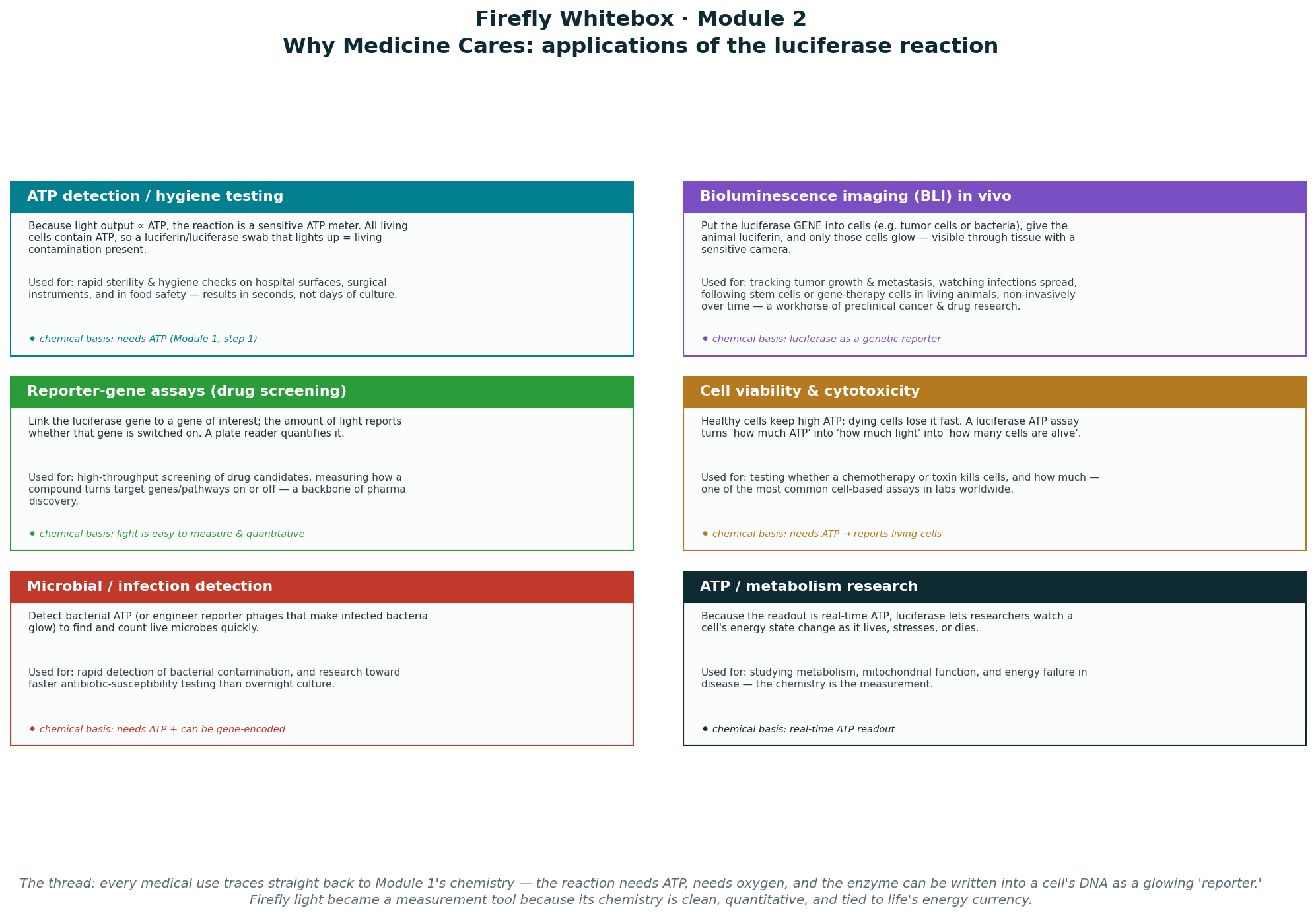
The thread: every use traces back to Module 1 — the reaction needs ATP (so light = living cells & energy), and the enzyme can be written into DNA as a glowing "reporter." Clean, quantitative chemistry tied to life's energy currency.