PCR Whitebox

The chemistry most PCR videos skip. Not "add reagents and cycle" — the real mechanism, the enzyme, the energetics, and why things go wrong.
a chemist's tool suite · see the forest, then each tree

The forest, in one breath

PCR copies DNA by repeating three temperatures. But why it works — and why it fails — is chemistry: two magnesium ions catalyze each base addition, a protein "hand" does the work, base-pairing energetics set every temperature, and a fixed set of ingredients each play a defined role. Understand those, and every PCR problem has a molecular cause and therefore a fix.

This suite walks through it one "tree" at a time. Each panel below is generated by its own Python script (included), so you can study, edit, and extend any part.

Module 1The reaction mechanism Module 2The polymerase enzyme Module 3The thermodynamics Module 4The components Module 5Failure modes
Module 1 · the tree at the center

The nucleotide-addition mechanism

What actually happens when one base is added: the two-metal-ion ("Steitz") mechanism. The primer's 3′-OH, activated by a magnesium ion, attacks the α-phosphate of the incoming nucleotide; pyrophosphate leaves; a new bond forms. This single reaction explains most of PCR.
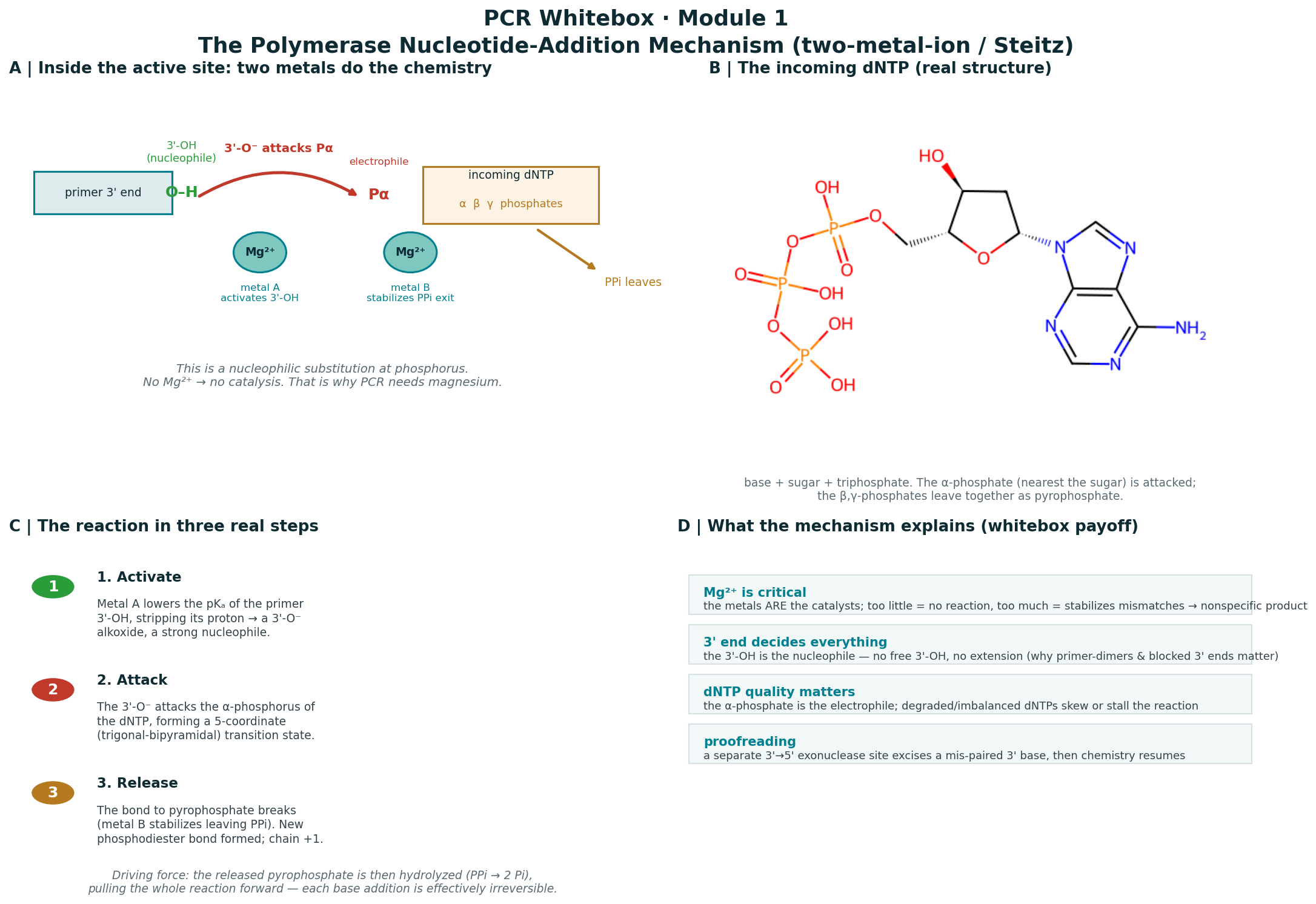
nucleotide addition mechanism
Why it matters: the metals are the catalysts (so Mg²⁺ is essential), and the 3′-OH is the nucleophile (so the 3′ end decides everything — including primer-dimers).
Module 2 · the machine

DNA polymerase — the enzyme

The protein that does the chemistry of Module 1. It folds like a right hand: fingers bind and test the incoming nucleotide, the palm holds the catalytic core and the two metals, the thumb grips the DNA, and a separate exonuclease domain can proofread.
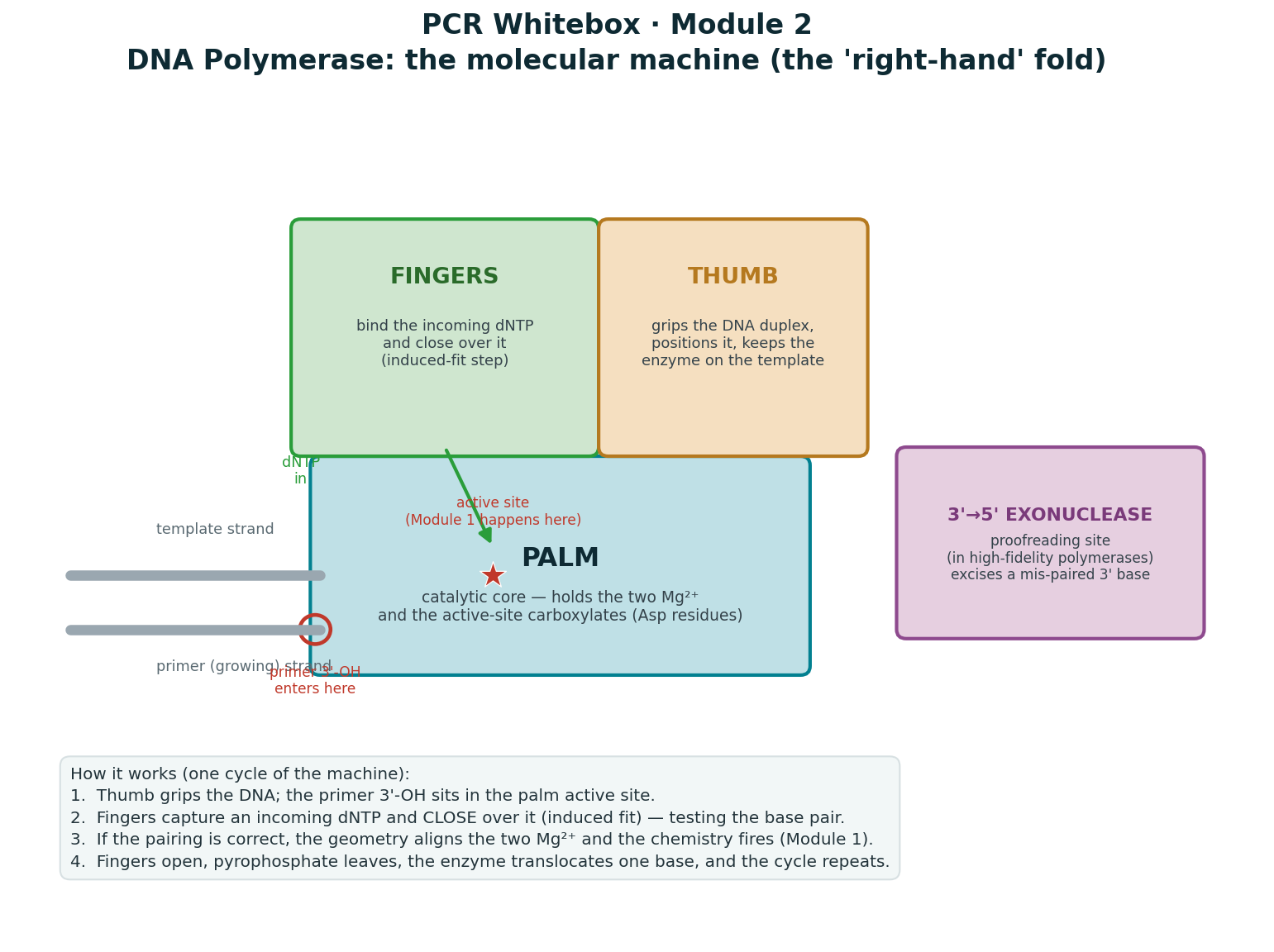
polymerase architecture
Real 3D structure: the script pcr_whitebox_polymerase.py will download the actual Taq/Klentaq crystal structure from the Protein Data Bank and write an interactive 3D viewer when you run it on your own machine (pip install py3Dmol requests). It's skipped automatically where the network is restricted.
Module 3 · why the temperatures

The thermodynamics of cycling

Computed from real nearest-neighbor energetics (SantaLucia parameters): each base-pair step has a measured ΔH and ΔS, which set a duplex's melting temperature. This is the quantitative reason 95 °C denatures, ~55–65 °C anneals (the specificity knob), and 72 °C extends.
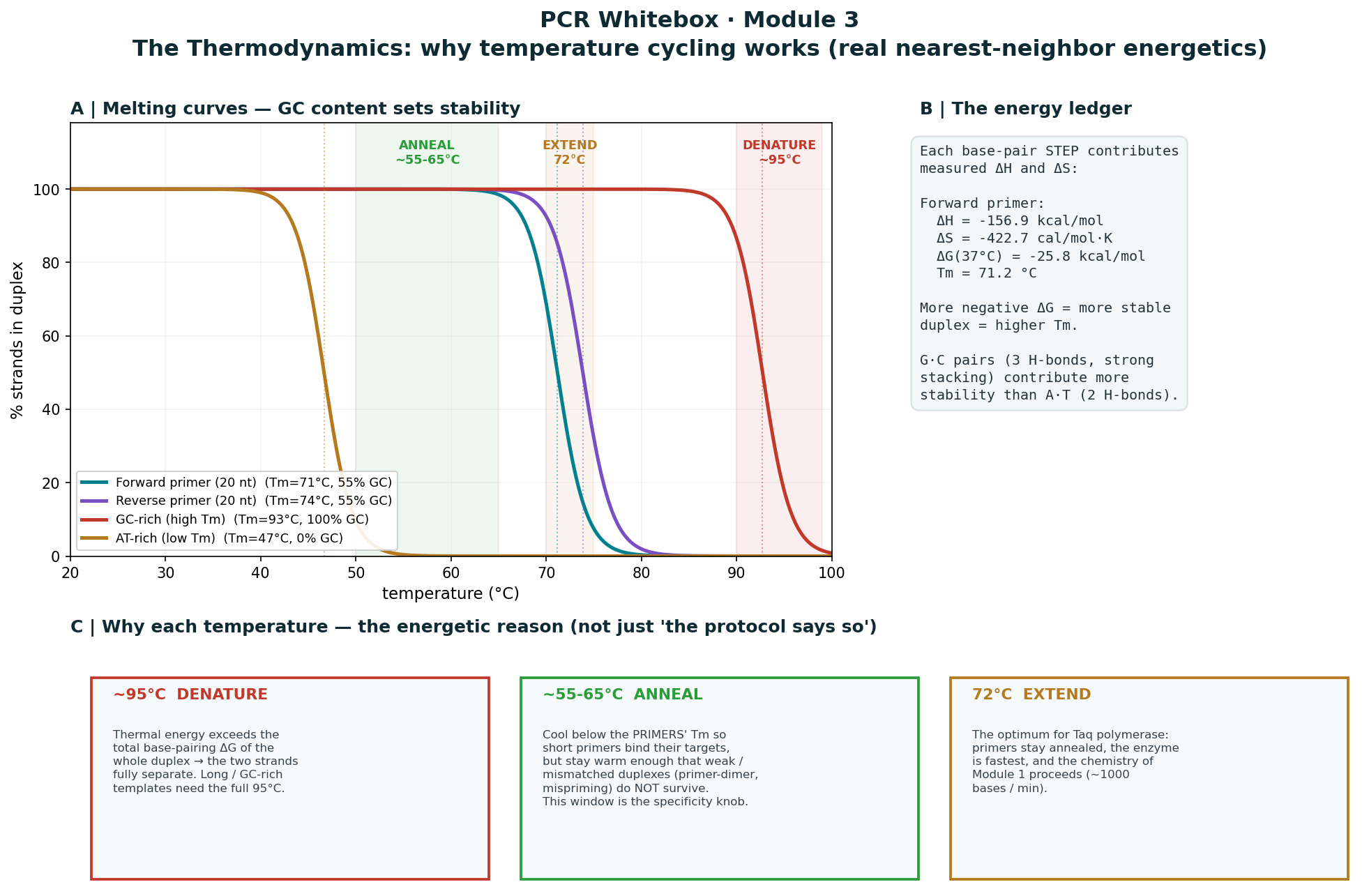
thermodynamics melting curves
Why it matters: the anneal temperature is your specificity control — warm enough to melt weak, wrong duplexes (primer-dimer, mispriming), cool enough to keep the right ones.
Module 4 · the ingredients

The reaction components

Every tube has the same handful of ingredients — but each has a defined chemical role in the mechanism, and a defined failure mode when it's off: magnesium (catalyst), dNTPs (substrate), primers (start points), polymerase (machine), buffer/pH (environment), and monovalent salt (duplex stabilizer).
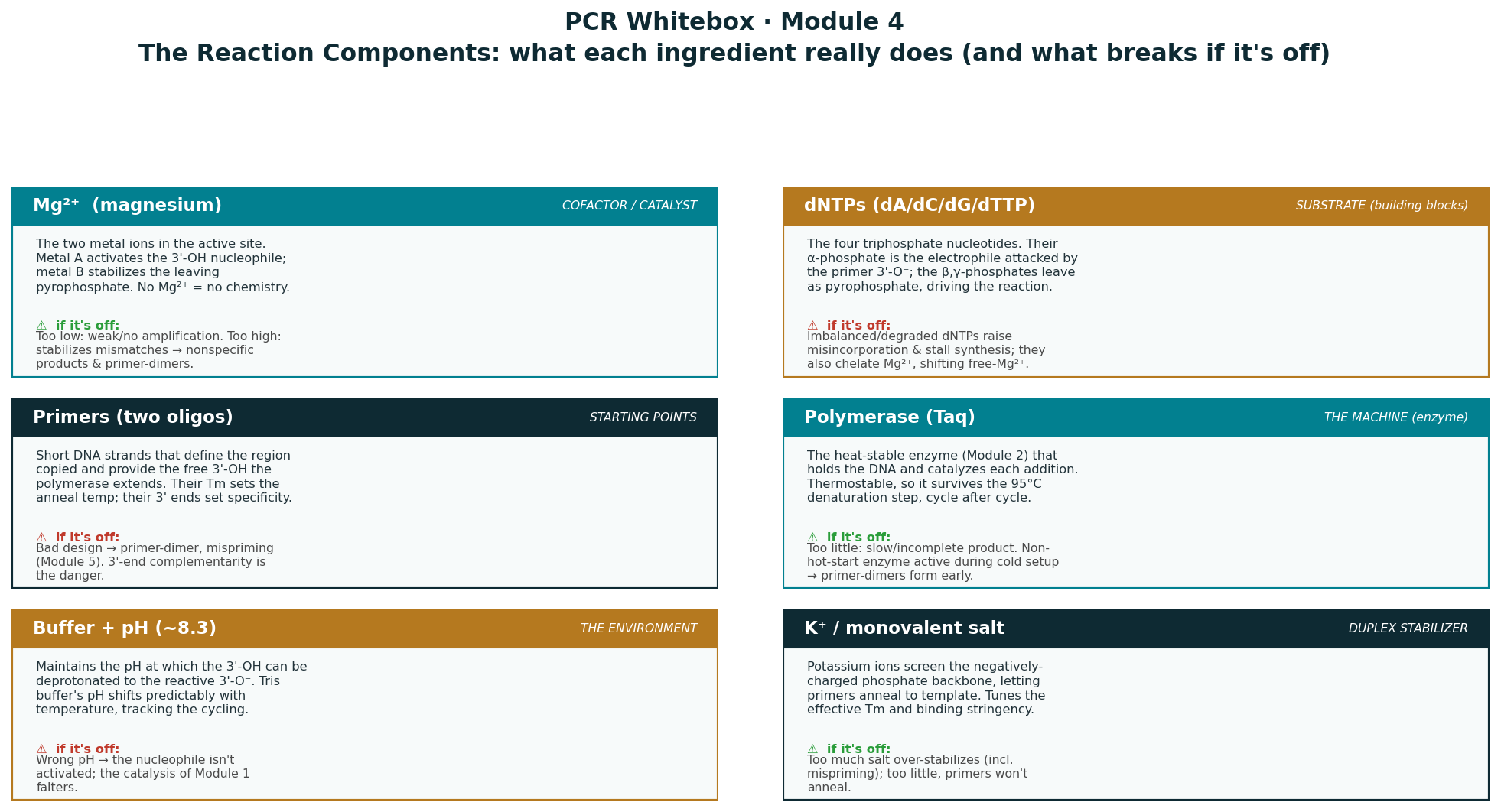
reaction components
Why it matters: when a run fails, this is the checklist — and each item connects back to a step in Module 1.
Module 5 · the payoff

Failure modes as chemistry

The diagnostic reward for understanding the first four modules. Primer-dimer, mispriming, nonspecific smear, plateau, no product, misincorporation — each explained by why it happens chemically and therefore how the mechanism says to fix it.
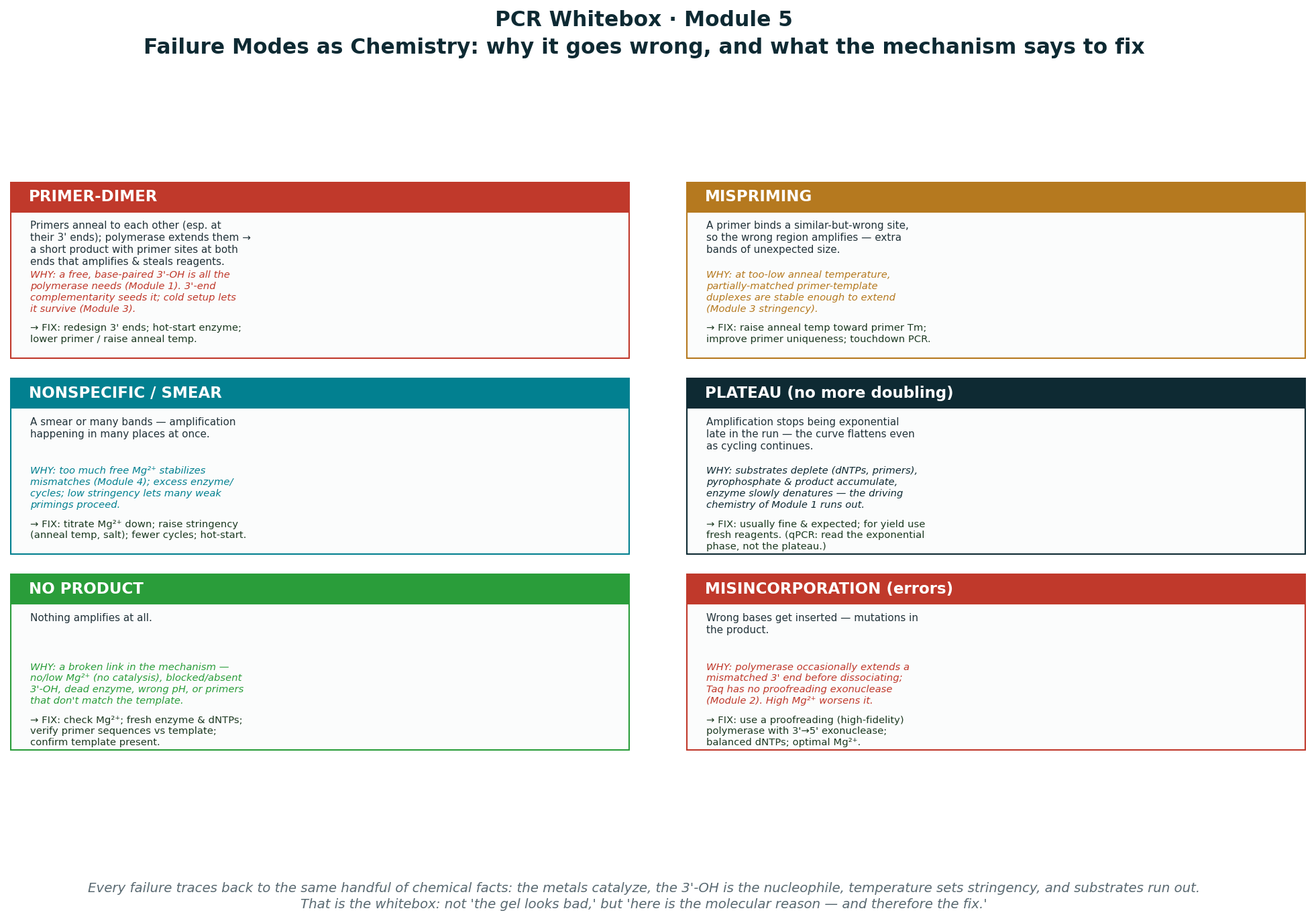
failure modes
The whole point: not "the gel looks bad," but "here is the molecular reason — and therefore the fix." That's the whitebox.